

From 1 November 2026 the European Union charges a customs handling fee of €2 per line of the customs declaration on goods sold at a distance to EU consumers and shipped from outside the EU, whatever their value. Under €150 it adds to the flat €3 customs duty, so each line costs €5. It is not an Amazon fee, and it does not apply to goods already cleared into a European warehouse: if you sell from there, you do not pay it.
Amazon announced it on the seller forum a few days before it took effect. This guide covers who is affected, how it is counted and what to check on your prices.
The numbers to remember
- €2
- Handling fee, per line
- On every distance sale from outside the EU, at any value. Permanent and non-refundable.
- €3
- Flat customs duty, per line
- Only for shipments up to €150. Temporary: scheduled to run until 1 July 2028.
- €5
- Total per line under €150
- Excluding VAT. A shipment with two lines reaches €10.
What Amazon announced
The announcement separates two cases, depending on how you handle the shipment:
- Self-fulfilment (FBM): your carrier invoices you for the fee and pays it to customs. Paying the carrier is your responsibility
- Remote Fulfillment with FBA: Amazon includes the fee in the price shown on the product page, in the basket and at checkout, so customers may see a higher price than the one you set
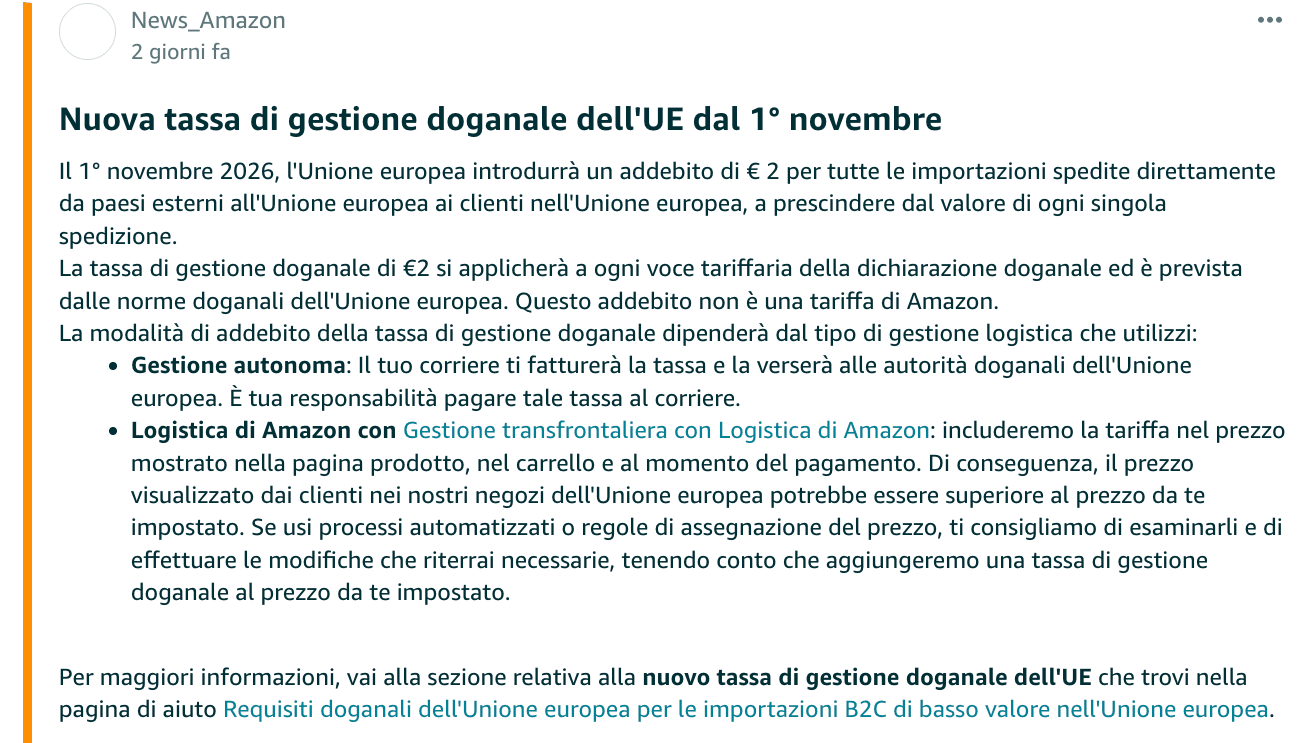
The second case is the one most likely to catch you out: Amazon itself suggests reviewing automated processes and pricing rules, because the fee is added to the price you set.
What the rules say
The fee comes from Article 20 of the new Union Customs Code and the amount is set by Delegated Regulation (EU) 2026/2152. The European Commission's guidance and the Italian customs agency clarify the points that matter to sellers:
- It applies at any value: unlike the €3 duty, it also covers shipments above €150, which pay standard duty on top
- It is permanent: the €3 duty is scheduled to run until 1 July 2028, the fee has no end date
- It is non-refundable: if the customer returns the product, the fee does not come back
- It is subject to VAT: under IOSS, if you charge it to the customer it goes into the IOSS taxable amount; under other schemes it goes into the import VAT base
- The declarant owes it: the IOSS holder, the Special Arrangements user or the indirect customs representative
Does it affect you? Two questions
How to work it out
When the customer buys, are the goods still outside the EU?
No, they are already cleared into an EU warehouseno fee and no €3 duty
Yes
Is the customer a consumer?
No, a business with a VAT numbernormally not a distance sale, so out of scope
Yes
Self-fulfilment
Your carrier invoices you for the fee. To protect your margin, you have to adjust the price yourself.
Remote Fulfillment with FBA
Amazon adds the fee to the price you set. The customer sees a higher price, and conversion may suffer.
One case to keep in mind is the customs warehouse. Under the Commission's guidance, goods sold to consumers while stored in a customs warehouse are not yet in free circulation, so they do not count as stock already imported. From 1 July 2028 a reduced fee is planned for a new type of warehouse dedicated to distance sales, but the amount has not been set yet.
How it is counted: per line, not per parcel or per piece
A line groups the products in a shipment that share the same tariff classification, the same description and, where required, the same origin. Quantity does not matter. Two examples, based on the ones the Italian customs agency gives for the €3 duty:
- 5 identical T-shirts are one line: €2 fee and €3 duty, €5 in total
- 1 T-shirt and 1 watch are two lines: €4 fee and €6 duty, €10 in total
One detail changes the sums: the level of the code depends on the type of declaration. In the guidance example, three women's suits in different fibres count as one line in the simplified H7 declaration, which uses the 6-digit code, and as three lines in the H1 declaration, which uses the 10-digit code. If you ship orders with several products, ask your forwarder how the declarations are filled in.
How much it takes from your margin
Same customs code and same description count as one line, whatever the quantity.
- Handling fee
- €2.00
- Flat customs duty
- €3.00
- Extra cost per order
- €5.00
- Of the value of the goods
- 20%
- Margin if you absorb it
- €3.00
Rough estimate, excluding VAT. The €3 duty covers shipments up to €150 and is scheduled to run until 1 July 2028.
What to check if you ship from outside the EU
The same amount does not weigh the same on every product. On a €15 order, €5 is a third of the value of the goods. On a €200 order, the fee is 1%, plus standard duty. So here is what to check:
- Repricers and pricing rules: with Remote Fulfillment the fee is added to the price you set, so a rule that chases a competitor can take you higher than you think
- Margin on FBM orders: the carrier invoices the fee separately. Update the margin for every SKU shipped from outside the EU
- Returns: the fee is non-refundable, and on products with many returns this cost has to go into the sums
- Orders with several products: two lines cost twice as much as one, so rerun the numbers on bundles and cross-sells shipped from outside the EU
- Product identifiers: from 1 November, for shipments up to €150, the seller's and the manufacturer's identifiers are required, plus the standard code where one exists. Check that your forwarder has this data
- Stock in Europe: if volumes justify it, compare these costs with importing in bulk and selling from European warehouses
If your goods are already in Europe
If you sell with FBA or from an EU warehouse with goods already imported, you pay neither the fee nor the €3 duty. The rules still matter to you in another way. According to the Commission, 5.9 billion low-value items sold online entered the EU in 2025, and those who ship them directly now pay €5 per line under €150.
That does not mean those competitors will disappear. Some will raise prices, others will move stock into Europe and then deliver faster too. So it is worth keeping an eye on the offers in your categories and watching how prices move in the coming weeks.
This is the general picture as of 1 November 2026, not customs advice: for specific cases, talk to your forwarder or a customs consultant. If you want to see how much it weighs on your catalogue and how to review your prices, let's talk.