


On Amazon.it, limited-time deals such as Black Friday deals show the product's lowest price in the last 30 days before the reduction next to the deal price, with the discount percentage calculated against it. Showing that price is an obligation under Article 17-bis of the Italian Consumer Code. So raising your price in the weeks before the event does not inflate the discount, as long as the old price is still inside the 30-day window. And the price you charge between 19 and 30 November stays in that window for most of December, which makes it the benchmark for your Christmas deals.
Black Friday Week on Amazon.it started on 19 November and ends with Cyber Monday on the 30th. On 2 November Amazon posted an event checklist in the Italian seller forum. Among other things, it asks sellers to make sure their promotional prices meet the minimum discount threshold and to fix suppressed or at-risk deals quickly.
What the customer sees on the page
On a Black Friday deal, the price box can show two crossed-out lines. The first is the RRP, with the bigger discount. The second is the Lowest price in last 30 days, with the discount against the lowest price of the previous month. In the example below, the same price is 50% off the RRP and 16% off the lowest price of the last 30 days.
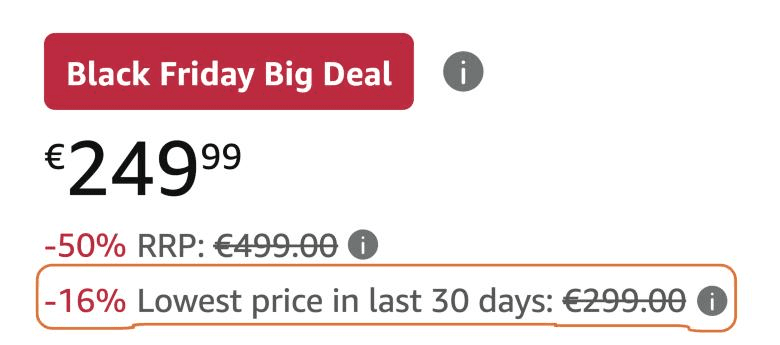
Click the icon next to the second line and Amazon explains that, for price reduction announcements, it shows the product's lowest recent price on Amazon.it for the 30 days before the reduction. The definition refers to the product, not to your offer alone. If resellers also sell on the same ASIN, their prices over the past weeks may count too, which is one more reason to keep an eye on who sells your brand, as we explain in our guide to unauthorized sellers.
What the rule says
Article 17-bis of the Italian Consumer Code, added in 2023 by Legislative Decree 26/2023 to implement the Omnibus Directive, requires every announced price reduction to show the prior price. The prior price is the lowest price the seller charged consumers in general in the 30 days before the reduction. Every EU country has transposed the same directive into its own law, with some national differences. The Italian rule includes a few special cases:
- Progressive reductions. If the discount grows within the same uninterrupted campaign, the prior price for the later reductions stays the price before the first one. A discount that starts on 19 November and deepens on the 27th is still compared with the price before the 19th.
- New products. For products on sale for less than 30 days, the seller states the period the prior price refers to.
- Exclusions. The 30-day rule does not apply to perishable agricultural and food products.
Breaches carry administrative fines. This is a general overview of the rule, not legal advice, and borderline cases need a professional opinion.
Recommended price and median price
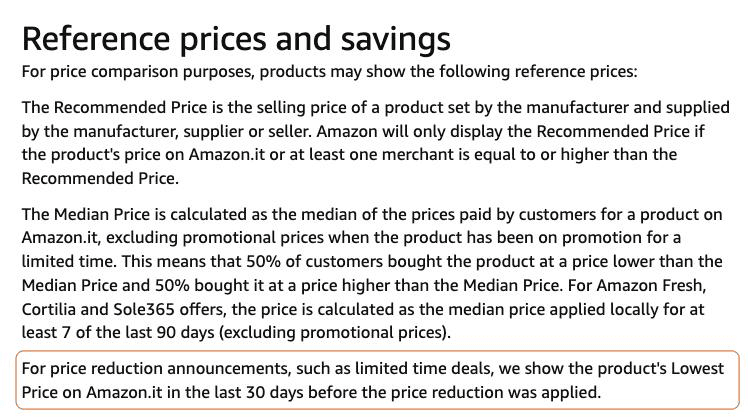
The other references Amazon may show are described on the Reference prices and savings help page. The Recommended Price is set by the manufacturer, and Amazon only displays it if the product has sold at or above that price, on Amazon.it or at least one other merchant. An RRP nobody has ever charged won't appear. The Median Price is the median of the prices customers paid on Amazon.it, excluding limited-time promotional prices. These are comparison prices. For price reduction announcements such as limited-time deals, Amazon shows the lowest price of the last 30 days.
Your Black Friday price weighs on December deals
The discounted price you charge these days enters the 30-day window and stays there. Here is an example with made-up numbers. A product sells for €40, goes on deal at €32 from 24 to 30 November and returns to €40 on 1 December. If you launch a Christmas deal at €34 on 12 December, the lowest price of the previous 30 days is €32, and against that reference €34 is not a reduction. To have a discount to show, you need to go below €32. The 30 November price only drops out of the window for reductions starting on 31 December.
Amazon also sets its own requirements for limited-time deals, which you see in Seller Central when you create the deal and which come on top of the law. A December deal that doesn't beat the Black Friday price may have no discount to show. In its 2 November announcement, Amazon asks sellers to check exactly these suppressed or at-risk deals.
What to check before 27 November
Friday the 27th is Black Friday and Monday the 30th is Cyber Monday. For the products you put on deal, run these checks:
- The 30-day low. For each product, work out the lowest price of the past month, including resellers on the same ASIN. That is the number the customer measures your discount against.
- No last-minute increases. A price rise in the last few weeks doesn't change the reference, because the old price is still in the window, and it can cost you sales in the meantime.
- Discounts in stages. If you deepen the discount between Black Friday and Cyber Monday without a break, the prior price under the rule stays the one before the first reduction. After the change, check which reference Amazon shows on the page.
- Your December plan. Decide your Christmas promotions now. If you want one with a visible discount, the price has to go below your Black Friday price. Otherwise, use other levers, such as advertising on full-price products.
- Your margin. A lower price also changes how much you can spend on ads. Redo the maths as we explain in our article on break-even ACOS.
Pricing, promotions and the deal calendar are part of our account management work. If you want to plan your December promotions around your Black Friday prices, let's talk.